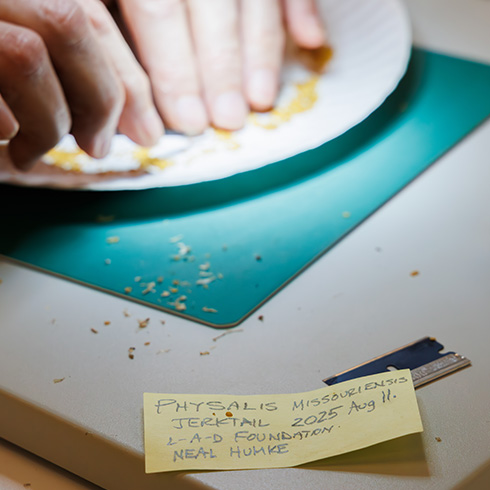
Hands working with seeds

Hidden behind the scenes at the Missouri Botanical Garden is a powerful conservation resource: the Seed Bank. Here, seeds from plants around the world are carefully collected, dried, and stored at low temperatures, preserving their ability to grow for decades—or even centuries.  

Long used as a method for storing crops, seed banking is an increasingly critical tool in wild plant conservation. This work is known as ex situ conservation—protecting species outside their natural habitats—and it plays a critical role as plants face rapidly increasing threats of extinction. While conserving plants in the wild (in situ conservation) remains essential, seed banking provides a vital backup, ensuring that genetic diversity is not lost and can be used to support research, restoration, and species recovery in the wild. 
 

Learn More About Ex Situ Conservation at the Garden


Our Collections

At the Missouri Botanical Garden, seed banking has been an essential part of our conservation mission since the 1980s. In 2013, the Garden established a dedicated Seed Bank at Shaw Nature Reserve to support both regional and global plant conservation efforts, aligned with international goals to safeguard threatened species. 

Today, the Seed Bank is housed in an expanded facility at the Garden’s Oertli Hardy Plant Nursery, with room for future growth and enhanced capacity. As of late 2025, it holds 9,678 accessions representing 1,511 species from 20 countries and 30 U.S. states. This includes nearly 40% of Missouri’s native flora (942 species) and 81 species in the Center for Plant Conservation’s National Collection of Endangered Plants, for which the Garden serves as custodian or co-custodian.  
 

Search Our Collections at livingcollections.org


Using Our Seeds

Our seed collections are an active resource for conservation practitioners, researchers, land managers, and educators, providing both plant material and high‑quality data to support responsible use.  

Seed material is available to qualified users for non‑commercial conservation, research, and restoration purposes, subject to availability and applicable agreements. 

To request seed material: 

  1. Review accession availability at livingcollections.org 

  1. Submit a Plant Material Request Form 

  1. Requests are evaluated based on conservation priorities, seed availability, and intended use 


Training & Collaboration

The Garden offers conservation and collections management training in a variety of formats—ranging from in-person workshops to virtual and in-country training—across a range of topics related to seed conservation and plant collections. 

We are currently exploring ways to formalize these offerings and value your input. 

We invite seed conservation practitioners to share their interests and perspectives through the survey below. As our programming takes shape, we will follow up accordingly. 
 

Garden Seed Conservation Training Interest Survey


Seed Conservation Techniques International (SCTi) — First Cohort, April 20–24, 2026

The Missouri Botanical Garden is excited to announce that we are accepting applications now through March1st for our first-ever cohort of Seed Conservation Techniques International (SCTi), taking place April 20–24, 2026.

SCTi follows the Millennium Seed Bank Partnership (MSBP) Seed Conservation Standards, which outline global best practices for the long-term conservation of wild plant seeds. Delivered by an MSBP Certified Trainer, the course builds practical skills and supports high-quality, consistent implementation of seed conservation standards. The training covers the full seed conservation workflow and is adapted to local and regional contexts.


Learn More and Register Here


Learn More

Curious to go deeper into seed banking and the Missouri Botanical Garden’s role in global plant conservation? 

Seed banking is one of the ways Missouri Botanical Garden works to discover and share knowledge about plants and their environment, in order to preserve and enrich life