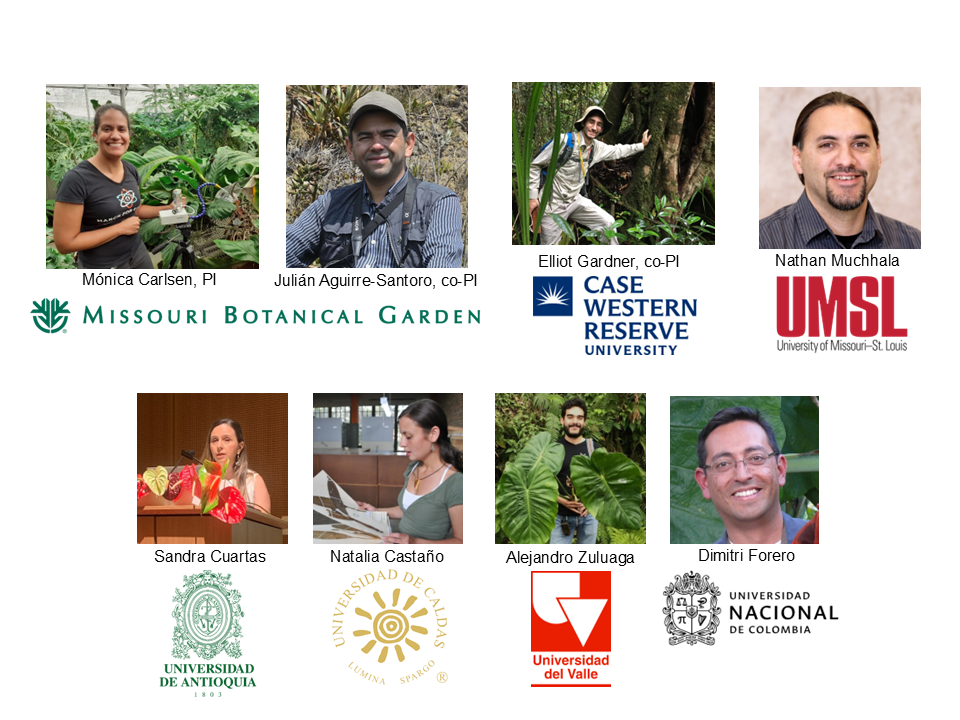
Mentorship from U.S. and Colombian researchers
Students will be trained in all aspects of research, including project design, background research using library and electronic resources, methods, data collection and analysis, and presentation of results in scientific posters and manuscripts. Students will work closely with a Ph.D. mentor from collaborating U.S. and Colombia-based institutions in one of the following independent research projects:
Project #1: Do sympatric Anthurium species differ in floral scent composition and therefore attract different pollinators? In Anthurium, where morphological and phenological barriers to pollinator discrimination are minimal, floral scent divergence may be crucial for mediating pollination specificity and coexistence in sympatric species. It is hypothesized that sympatric Anthurium species will exhibit distinct floral scent compositions, leading to pollination by different insect groups.
Project #2: Are olfactory cues alone sufficient for pollinator attraction in Anthurium? Bee-pollinated Anthurium species share a pleasant floral scent, thought to be important in attracting and influencing pollinator behaviors. These species also tend to share other floral traits, such as diurnal anthesis and bright yellow or cream flower color. Bees have excellent color vision and can discriminate between various flower colors and patterns, suggesting that visual attraction cues could also play a role in pollinator attraction.
Project #3: Are bee-pollination systems in Anthurium more specialized than systems involving other insect pollinators? A few studies have suggested that bee-pollinated Anthurium species often exhibit high pollinator specialization (i.e., unique and non-overlapping pollinator species) driven by floral scent differentiation. In contrast, Anthurium species pollinated by other insects tend to have a more diverse set of visitors within the same functional group (e.g., flies). This suggests that specialized pollination systems in Anthurium may be characterized by fewer visitors and more distinct pollinator sets even when species occur in sympatry.
Project #4: Can pollination syndromes be predicted based on the volatile organic compounds of the floral scents? If floral scent composition can reliably distinguish between bee- and non-bee-pollinated Anthurium species, as supported by a preliminary analysis, then machine learning models could predict pollination systems for species without empirical pollinator observations, based on their volatile organic compounds profiles.
Important dates
- January 15th: Application period closes.
- February 1st through 10th: Online interviews for selected applicants.
- February 20th: Selected IRES students receive program and travel information.
- February 28th: All applicants (whether accepted or not) will be notified via e-mail.
- March 1st through May 31st: three-month Virtual Pre-Departure Program (weekly, one-hour Zoom sessions).
- June 1st through August 10th: eight-week International Research Experience in Colombia (with flexibility in travel timelines).
- September 1st to December 1st: three-month Virtual Post-Travel Program (weekly, one-hour Zoom sessions).
Eligibility
Undergraduate students enrolled full-time at a U.S. institution and returning to their program in the fall following their international experience. If you will be graduating in May/June or Summer in the year of the program you are not eligible.
Per NSF rules, applicants must be U.S. citizens or U.S. permanent residents (i.e. green card holders).
No prior international experience or knowledge of Spanish language required.
Students must be available to participate for the entire duration of IRES program activities (see also “Important dates”), including:
- Three-month Virtual Pre-Departure Program focused on preparations for international travel, Colombian culture, and research.
- Eight-week International Research Experience in Colombia where students will take part in training bootcamps, perform field research and data collection, and engage in cultural activities.
- Three-month Virtual Post-Travel Program focused on data analysis, research dissemination, and career development.
Funding & Support
IRES students will receive a $650 weekly stipend for the duration of the 8-week international research experience in Colombia. In addition, IRES students will have all travel to and within Colombia, lodging, and research expenses covered.
Safety and health guidelines
Students will be expected to comply with all laboratory, field, research and workspace safety guidelines as well as with all public health measures. While travelling abroad, all IRES students will receive travel health insurance.
Additional training
Informational sessions will guide IRES students in their professional development, covering topics such as pursuing STEM careers, applying to graduate school, and identifying research opportunities and funding. Other sessions will prepare IRES students for writing scientific manuscripts, developing scientific posters, and communicating science to non-technical audiences. Additionally, cultural enrichment is integral to the program, IRES students will participate in a variety of social and cultural exchange activities.
How to Apply
Application deadline: January 15th, 2026
To apply, please follow this link to the NSF-ETAP portal: NSF-ETAP Link
Application materials should include:
- Personal statement: a two-page (single-spaced) essay detailing research interests, motivation for participating, professional and personal goals, academic accomplishments and previous research experience (if any).
- Most recent academic transcript(s) from all colleges that you have attended (official and unofficial copies are fine)
- Letter of recommendation written on official university or agency letterhead and signed. We are looking for comments on the student's academic ability, motivation, work habits, and potential as a researcher. When selecting a recommender, please be sure they can comment on your potential for conducting research.
For more information, please contact the IRES-PI via email at: monica.monica.carlsen@mobot.org